


Discharging

Discharge Solutions in Industrial Material Handling
A critical part of the overall process.
Discharging containers such as big bags, drums, and sacks is a critical interface between raw material logistics and the core production process. Despite this, the importance of the discharge solution is often underestimated in plant design and process optimization.
An unsuitable discharge solution can result in increased operator exposure, unstable material flow, product waste, and limited throughput.
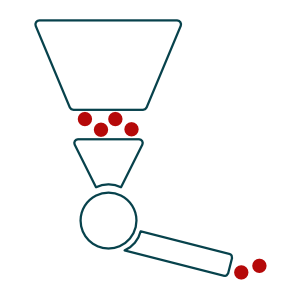
Conversely, a properly specified discharge solution can significantly improve the working environment, increase uptime, and provide enhanced process control. The choice of discharge solution is largely a technical and strategic decision that extends far beyond the discharge operation itself. By meticulously mapping material properties, ergonomics, process integration, flexibility, operating conditions, and containment requirements, companies can implement a stable, secure, and future-proof solution. A well-engineered discharge solution is not merely a necessary process step, but an active component in optimizing the overall production process.
Material-Technical Prerequisites
The physical and chemical properties of the material are decisive when selecting a discharge solution, as multiple parameters influence the risk of bridging, non-uniform discharge, and unpredictable material flow. In many cases, it is necessary to supplement the discharge system with vibration equipment, mechanical agitation, or flow aids to ensure complete and controlled emptying.
Powders and bulk solids can vary considerably with respect to:
- Particle size and morphology
- Flowability and cohesion
- Dust generation
- Moisture and temperature sensitivity
- Electrostatic properties
Containment, Safety, and Regulatory Requirements
Containment is a critical design parameter, particularly when handling hazardous, toxic, or active compounds. An effective discharge solution must minimize dust emissions and accidental exposure during routine operation as well as during cleaning, maintenance, and container changeouts. The required containment level should be specified early in the project phase and documented in accordance with applicable occupational health and safety regulations and internal risk assessments.
Key considerations include:
- Closed-loop connections between container and process equipment
- Controlled opening and closing of packaging
- Integrity levels under both dynamic and static conditions
- Cleanability without disassembly
Ergonomics and Mechanical Handling
Discharge solutions often involve manual handling, especially with sacks and drums. Inadequate ergonomics can lead to repetitive strain injuries, operational inefficiencies, and an increased risk of accidents. Mechanical handling should therefore be an integral part of the system design. Ergonomically optimized solutions enhance not only operator safety, but also process standardization.
Technical aspects include:
- Lifting and positioning equipment for heavy containers
- Minimization of manual lifting and twisting
- Consistent and intuitive operation
- Capability for single-operator operation
Process Integration and Material Flow
A discharge solution must operate reliably as an integrated component of the overall process. This requires rigorous evaluation of interfaces to downstream equipment such as dosing systems, load cells, conveying solutions, or mixers. Inadequate integration can result in bottlenecks, inconsistent dosing, and an increased risk of production downtime.
In this context, critical factors to address include:
- How is a constant and predictable material flow ensured?
- Is buffer capacity or flow regulation required?
- How does the discharge solution impact dosing accuracy and cycle times?
Degree of Automation and Flexibility
Manufacturing environments are rarely static. Variations in product portfolios, batch sizes, and throughput demands require versatile discharge solutions. Modular systems facilitate phased upgrades and reduce total investment risk.
This includes:
- Hygienic, easy-to-clean design
- Minimal requirement for consumables
- Easy access for service and inspection
- Robust engineering for extended service life
Operation, Cleaning, and Maintenance
Beyond the discharge function itself, emphasis must be placed on operational factors across the entire lifecycle of the system. A low-maintenance solution contributes to higher uptime and a lower total cost of ownership.
Powders and bulk solids can vary considerably with respect to:
- Particle size and morphology
- Flowability and cohesion
- Dust generation
- Moisture and temperature sensitivity
- Electrostatic properties