


Pneumatic Conveying

When powder needs to be conveyed through your production facility
Conveying with high reliability and flexibility
Production processes are often distributed over a large physical footprint, requiring powder to be conveyed both horizontally and vertically. Here, pneumatic conveying can be applied to transport the powder to its destination.
In its basic form, a pneumatic conveying system is built quite simply and is ideal for conveying powders and granules. It requires a compressed gas source such as air, a pick-up point, a piping system, and a receiver vessel. The receiver vessel separates the conveyed material from the conveying gas.
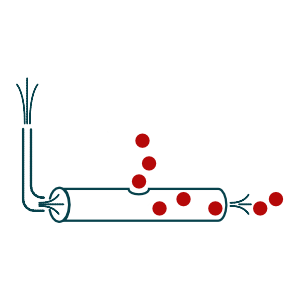
This occurs in a closed system that can operate entirely without moving parts in contact with the conveyed product. Pressure or vacuum can be utilized to convey the material.
Pneumatic conveying offers considerable flexibility in both plant layout and operation. There can be multiple pick-up points routed into a single conveying line, just as the conveying line can distribute to multiple destinations.
Pressure conveying
Positive pressure conveying is likely the most common form of pneumatic conveying. During the system design phase, it must be noted that positive pressure will be present at the material pick-up point. Several different components can be utilized at the material feed point in a pressure conveying system. The most common solution is a rotary valve configured as a drop-through rotary valve with a drop-out box or a blow-through rotary valve. In rarer cases, venturi injectors or dosing screws are used. Pressure vessels (blow pots) can also serve as the infeed in pressure conveying systems.
Advantages of pressure conveying:
- Can accommodate multiple pick-up points
- Can discharge to multiple delivery points
- Capable of conveying longer distances than a vacuum conveying system
- Can convey at higher capacities than a vacuum conveying system
- Can be configured as a continuous or discontinuous conveying system
- Receiver vessel with integrated batch weighing system
By utilizing diverter valves, material can easily be distributed to two or more receiver vessels. Multiple pick-up points can also be incorporated, where careful consideration in the design is once again essential, as significant pressure loss can occur across rotary valves.
For temperature-sensitive products, it may be necessary to cool the air downstream of the blower. Similarly, installing a dehumidifier may be required if the conveyed product is hygroscopic.
Vacuum conveying
A vacuum conveying system is generally used to draw materials from multiple pick-up points to a single receiver vessel. When handling powder products, the receiver vessel is equipped with a filter that separates the product from the conveying air. There is little to no pressure differential across the pick-up point, meaning multiple pick-up points typically present no issues. A vacuum system can often be designed without rotary valves and can represent a simpler, more cost-effective solution than a pressure conveying system.
Vacuum conveying systems offer the further advantage that leakages do not cause dust emissions, as can happen with pressure conveying systems. This is a critical parameter when handling, for example, toxic or explosive products.
The vacuum pump should also be protected against potential filter element breakthrough. This is typically ensured with a safety filter installed between the receiver vessel and the vacuum pump.
FAQ
Dilute phase
Dilute phase (low product-to-air ratio) means the conveyed powder or granules are suspended in the air stream, primarily as dispersed particles. This typically occurs at velocities exceeding 18 m/s. Virtually any powder or granule—regardless of particle size, shape, or bulk density—can be conveyed in dilute phase, provided the material can be fed into the pipeline in a uniform stream.
Dense phase
Dense phase (low air-to-product ratio) means the conveyed powder moves in plugs through the piping system, or as a moving bed along the bottom of the pipe. Conveying velocity is down to 3 m/s, and in some cases even lower. Dense phase is therefore ideally suited for abrasive products or fragile products that must not degrade during conveying. Furthermore, this results in minimal wear on pipes and bends, ensuring minimal maintenance and a long service life.
Design and testing
Bulk materials vary and can behave very differently within a conveying system. Some are highly cohesive, some are friable and cannot tolerate attrition, while others are very heavy or extremely light.
Prior to selecting a system, conducting trials with the supplier(s) considered capable of solving the task is strongly recommended. This provides assurance to both you as the customer and the responsible supplier that the system is engineered correctly.